Blogs

Token-Based Authentication: An Enterprise Perspective

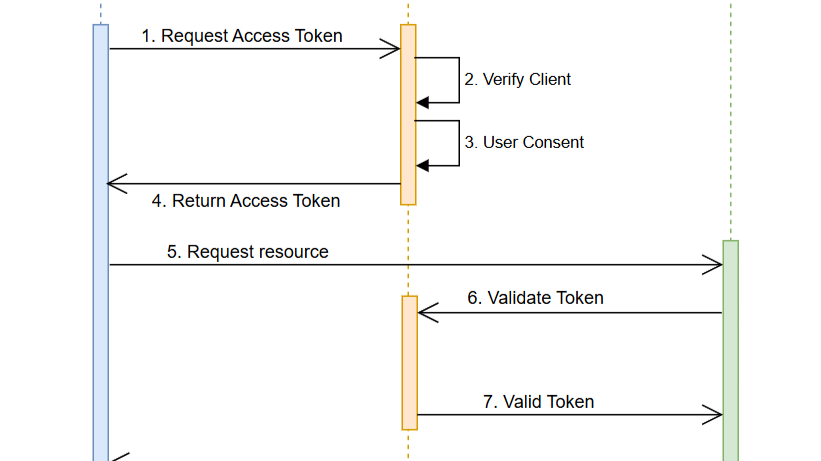
Understanding Token-Based Authentication: An Enterprise Perspective As enterprises grow increasingly digital, therefore securing sensitive customer data while enabling seamless user experiences has become a top priority. Token-based authentication—a key pillar of modern identity and access management—plays a crucial role in this context. At ByteCraft Labs, we frequently assist our clients in designing robust architectures for secure user authentication and authorization. In this article, we’ll break down the sequence of token-based authentication, as illustrated in the diagram above, and demonstrate its application through an eCommerce use case. Step-by-Step Explanation of Token-Based Authentication 1. Request Access Token: 2. Verify Client: 3. User Consent: 4. Returns Access Token: 5. Requests Resource: 6. Validate Token: 7. Valid Token: 8. Returns Resource: Token-Based Authentication in an eCommerce Context To better understand this workflow, let’s explore a practical use case in eCommerce: Scenario: A user wants to view their past purchases on an eCommerce platform. 1. The eCommerce platform (BusinessClient) requests access to the user’s purchase history by sending an access token request to the OAuth Server. 2. The OAuth Server verifies that the eCommerce platform is authorized to make such a request. 3. The user logs in and grants consent for the platform to access their purchase data. 4. The OAuth Server issues an access token to the eCommerce platform. 5. The eCommerce platform uses this token to request the purchase history from the ResourceServer. 6. The ResourceServer validates the token’s authenticity and checks if it has expired. 7. Upon validation, the ResourceServer retrieves the purchase history. 8. The eCommerce platform displays the purchase history to the user. Key Benefits of Token-Based Authentication Challenges and Best Practices While token-based authentication provides robust security, implementing it correctly requires adhering to best practices: Conclusion Token-based authentication is more than a mechanism—it is a foundational component of secure, modern enterprise applications. At ByteCraft Labs, we empower businesses with tailored solutions to leverage the potential of such technologies effectively. By understanding the intricate workflow and adopting best practices, enterprises can safeguard their data and deliver seamless experiences to their users. We’d love to hear your thoughts! How has token-based authentication transformed your application security strategy? Share your experiences in the comments below. #ByteCraftLabs #SoftwareDevelopment, #OAuth

Generative AI – Curriculum-Based Assistance

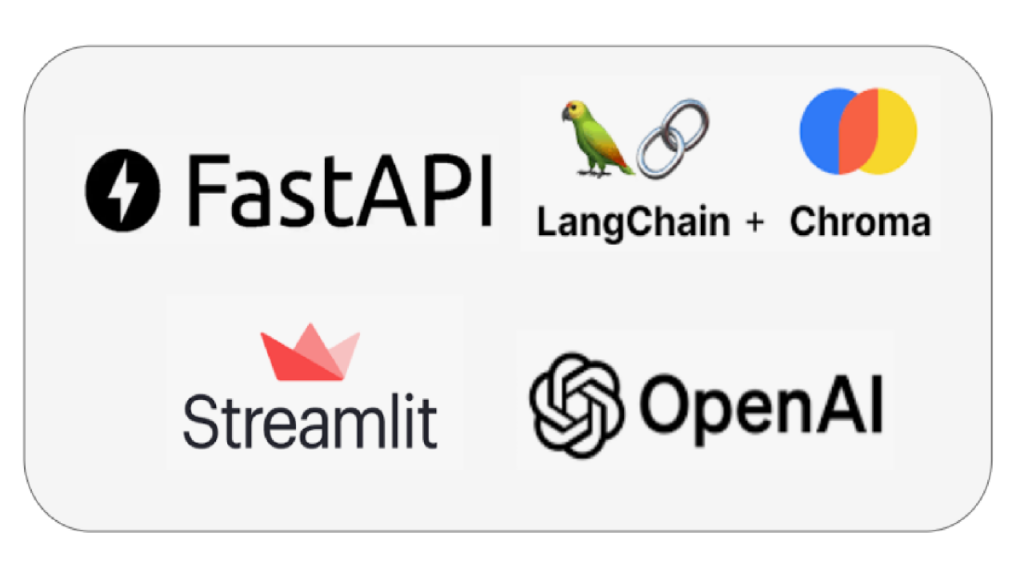
Generative AI – Curriculum-Based Assistance with RAG by ByteCraft Labs At ByteCraft Labs, we are at the forefront of Generative AI innovation, delivering cutting-edge solutions to redefine the learning experience. One of our recent achievements involves leveraging Retrieval-Augmented Generation (RAG) models to provide “Curriculum-Based Assistance” for students in a school management system. RAG combines the power of retrieval systems and large language models (LLMs) to provide context-aware and accurate responses. The solution ensures that responses are not just generated from an LLM but are enriched with curriculum-specific content uploaded by the educators. Architecture Overview The image illustrates our solution architecture, comprising several integrated components: Workflow Benefits of ByteCraft Labs’ Solution By leveraging RAG and state-of-the-art tools, ByteCraft Labs is empowering schools to provide students with AI-powered assistance that enhances their educational journey. With expertise in Generative AI, we are ready to tackle diverse industry challenges with similar innovative solutions. #ByteCraftLabs #GenerativeAI #RAGModels #LangChain #ChromaDB #OpenAI #Streamlit #FastAPI

Modular Monolith Architecture

Embracing Modular Monolith Architecture: A Pragmatic Approach to Scalability and Maintainability In the ever-evolving world of software architecture, terms like monoliths, microservices, and modular monoliths often dominate conversations. At ByteCraft Labs, where innovation meets practicality, we aim to demystify these concepts and guide enterprises toward optimal architectural choices. Today, let’s delve into the concept of Modular Monolith Architecture, an approach that harmonizes the simplicity of monoliths with the structural organization of microservices. What is Modular Monolith Architecture? A modular monolith is a software architecture paradigm that emphasizes designing a single deployable application with distinct, well-defined modules. Each module encapsulates specific functionality and interacts with others through clear interfaces, much like the service boundaries in microservices but without the overhead of distributed systems. Unlike a traditional monolithic architecture, where components are tightly coupled and lack clear boundaries, a modular monolith enforces separation of concerns. This makes the codebase easier to maintain, scale, and evolve over time. Key Features of Modular Monoliths When to Choose Modular Monolith Architecture Modular monoliths often serve as a middle ground between traditional monoliths and microservices. Here are scenarios where they shine: Modular Monolith vs. Monolith and Microservices Best Practices for Modular Monolith Architecture Visual Representation of Modular Monolith Architecture To better understand the modular monolith concept, the following diagram illustrates its structure: In this architecture: This visualization reinforces the principles discussed and highlights how a modular monolith combines simplicity and organization within a single deployable unit. Conclusion The modular monolith strikes a perfect balance for teams and enterprises that need the agility to innovate while managing complexity. It provides the foundation for scaling into microservices if necessary while avoiding premature optimization pitfalls. At ByteCraft Labs, we’ve seen firsthand how this approach empowers organizations to build robust, maintainable systems that stand the test of time. If you’re considering transitioning to or adopting a modular monolith architecture, reach out to ByteCraft Labs. Let’s build the future, one module at a time. #ByteCraftLabs #EnterpriseArchitecture #ModularMonolith #SoftwareArchitecture #Microservices

Mobile Platform Usage and Market Share (2019–2024)

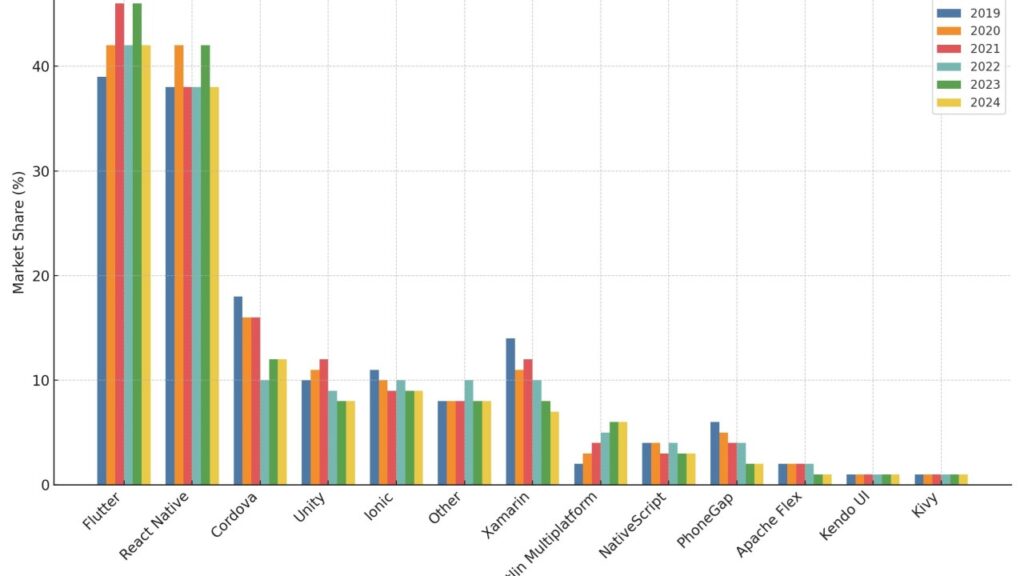
At ByteCraft Labs, we continuously analyze emerging trends in mobile application development to deliver innovative solutions to our clients. This article highlights the evolution of popular mobile app usage and Mobile platform Usage and Market Share (2019–2024), reflecting significant shifts in developer preferences and technology adoption. Visual Overview The bar chart below showcases the market share trends of leading Mobile Platform Usage and Market Share from 2019 to 2024. It vividly highlights the rise of modern cross-platform frameworks like Flutter and React Native and the decline of older technologies. For more information click here! Key Insights of Mobile Platform Usage 1. Continued Dominance of Flutter and React Native Flutter and React Native remain at the forefront of mobile development frameworks, sustaining their strong positions. 2. Decline of Legacy Frameworks Older frameworks like Cordova and PhoneGap continued to lose market share, marking a developer transition toward modern solutions. 3. Growth of Kotlin Multiplatform Kotlin Multiplatform has shown steady growth, reaching approximately 12% in 2024. Its promise of shared code between mobile and backend applications resonates with developers seeking efficiency and scalability. 4. Niche but Stable Platforms Certain frameworks have retained niche positions: 5. Minimal Adoption of Peripheral Frameworks Frameworks like Kendo UI and Kivy remained at minimal adoption levels, reflecting limited traction among mainstream developers. Conclusion The data for 2024 reaffirms the industry trend toward modern, versatile, and high-performance cross-platform frameworks. Flutter‘s steady growth and React Native‘s robust hold demonstrate developers’ preference for frameworks enabling rapid development and native-like experiences. The decline of legacy technologies highlights a clear shift toward tools that provide better performance, developer experience, and community support. At ByteCraft Labs, we leverage such insights to deliver future-ready solutions tailored to our clients’ needs. By staying attuned to technological advancements, we ensure our services empower businesses to achieve their goals seamlessly.