
Automating Financial Transaction Clearing through a Modular Microservices Architecture
At ByteCraft Labs, we partnered with a leading financial product company to modernize their legacy transaction clearing and settlement process. The goal was to build a secure, automated, and scalable platform that minimizes manual intervention, improves reconciliation accuracy, and ensures end-to-end auditability. This case study outlines the challenge, our solution, and the measurable impact achieved.
Problem Statement
The client, a large financial enterprise, faced recurring challenges with transaction processing and clearing between multiple internal systems and external settlement partners. Their legacy workflow relied heavily on manual file handling, batch uploads, and delayed reconciliation cycles. This is not only the introduced operational delays but also created compliance risks and limited visibility across transaction lifecycles.
Solution Overview
ByteCraft Labs designed a microservices-based architecture that automated the entire clearing and reconciliation workflow. Each microservice handled a specific responsibility—ranging from transaction capture to validation, encryption, and reconciliation—ensuring high modularity, security, and scalability.
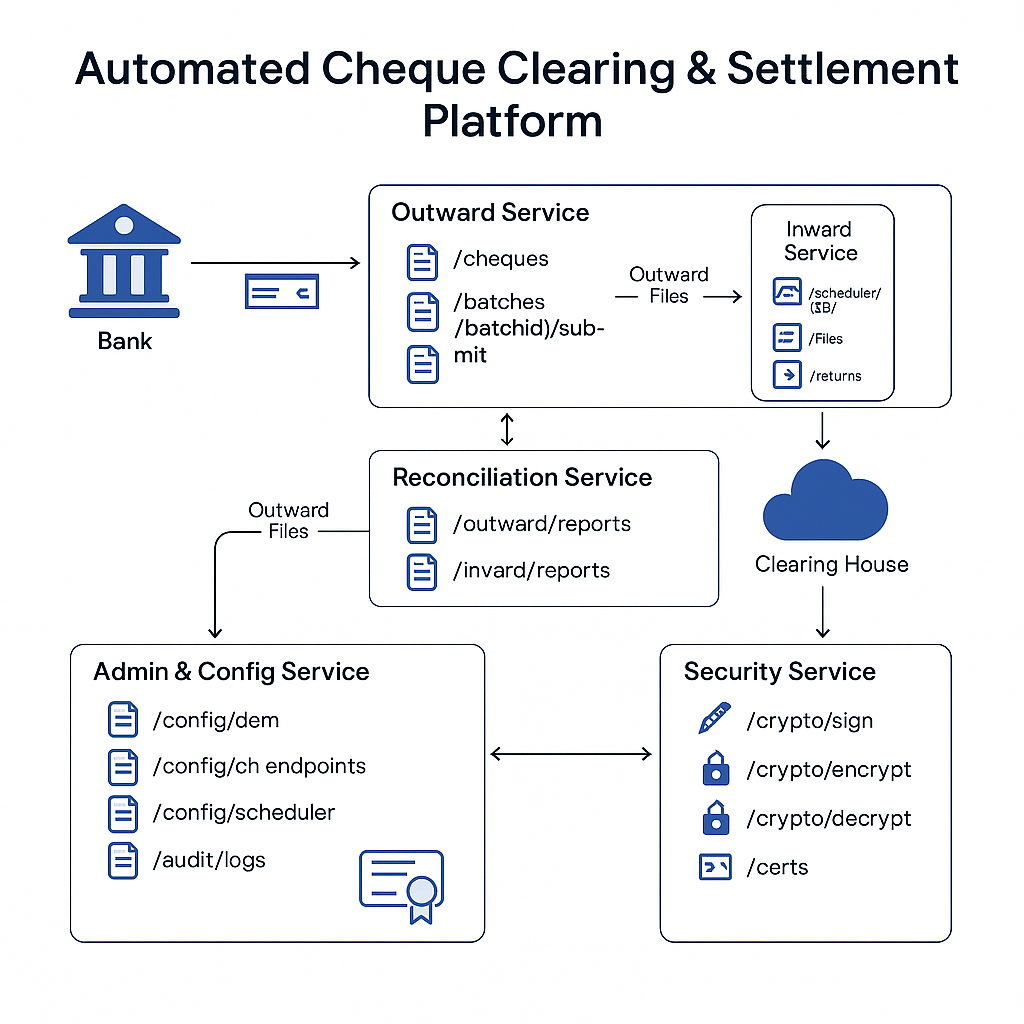
The solution was composed of five core services:
- Outward Service API – Automates transaction capture, batch generation, and secure submission to clearing systems.
- Inward Service API – Manages secure polling, decryption, validation, and decisioning for incoming transactions.
- Reconciliation Service API – Tracks acknowledgments, monitors discrepancies, and generates operational and audit reports.
- Admin & Config Service API – Centralizes configuration, scheduler management, failover controls, and audit logs.
- Security Service API – Provides encryption, decryption, signing, and key lifecycle management integrated with secure vaults or HSM.
Architecture & Flow
The system follows an event-driven, API-first design using a secure service mesh for intercommunication. The system captures outbound transactions, packages them into batches, and securely transmits them to clearing systems. Inbound transactions are fetched periodically, decrypted, validated, and processed through automated decision workflows. Reconciliation Service correlates acknowledgments, generates reports, and provides insights to operational teams. Configuration, scheduling, and encryption operations are centrally governed through the Admin and Security services.
Business Impact
| Metric | Before Implementation | After Implementation |
| Transaction Processing Time | 2–3 hours | < 20 minutes |
| Manual Intervention | High (60%) | Minimal (< 10%) |
| Reconciliation Errors | ~3% | < 0.1% |
| Audit Trail Coverage | Partial | 100% Automated |
| System Scalability | Limited | Horizontally Scalable Architecture |
Business Value Delivered
- Enhanced operational efficiency with automated processing and reconciliation.
- Modular microservices architecture enabling independent scaling and upgrades.
- Stronger security posture through isolated cryptographic operations and secure key management.
- End-to-end auditability and compliance reporting built into the workflow.
- Cloud-ready and environment-agnostic design adaptable for any financial ecosystem.
Conclusion
This engagement demonstrates how ByteCraft Labs leverages modern engineering principles—such as event-driven design, microservices, and secure DevOps practices—to transform complex legacy financial workflows into real-time, intelligent, and compliant systems. The solution architecture is not only the optimized efficiency but also provided the foundation for future innovations like AI-based anomaly detection and predictive reconciliation.
#ByteCraftLabs #FinTech #Microservices #Automation #DigitalTransformation #FinancialInnovation